

One of the most common concerns people have before deleting tweets in bulk is simple:
"Am I allowed to do this?"
Given how often X.com changes its rules, APIs, and policies, it's a fair question. This article explains what automated tweet deletion actually is, how X.com treats it, and why automating your own actions is fundamentally different from using third-party services.
The Key Difference: Acting As You vs Acting For You
All tweet deletion methods fall into two categories:
- You perform the action
- A third party performs the action on your behalf
This distinction matters more than most people realise.
When you delete a tweet manually:
- You are logged in
- You click delete
- X.com processes the request
- The tweet is removed
Automated manual deletion simply repeats that same action, faster.
What Automated Manual Deletion Actually Does
Automated manual deletion:
- Uses your own browser
- Uses your own login
- Uses your cookies and active session
- Clicks the same buttons you would click
- Sends the same requests your browser already sends
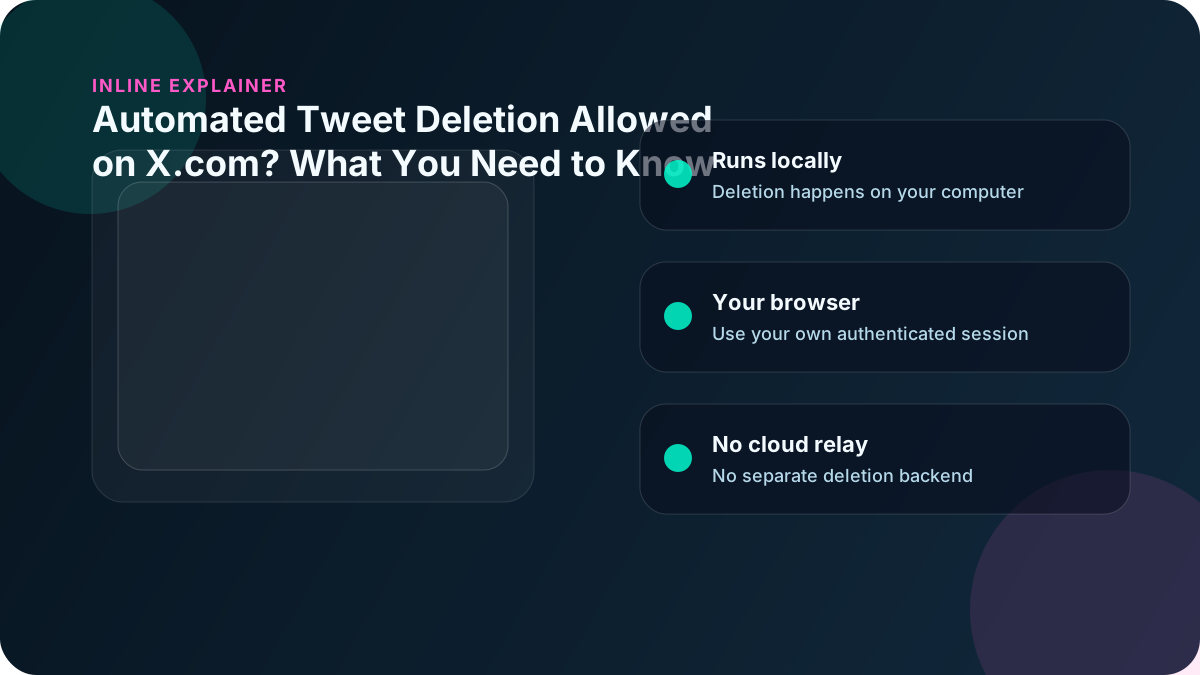
From a technical and behavioural standpoint, it is indistinguishable from normal user activity, except for speed.
There is no special access, no elevated permission, and no external system acting on your behalf.
How This Differs From API-Based Tools
API-based tools:
- Require explicit permissions
- Use access tokens
- Perform actions from external servers
- Depend on rate limits and policy changes
This is why API tools:
- Break frequently
- Get restricted
- Move behind subscriptions
- Stop working entirely when policies change
Automated manual deletion avoids APIs altogether.
If X.com allows you to delete a tweet manually, automation can perform the same action, because it is the same action.
How This Differs From Cloud-Based Services
Cloud-based services introduce delegation:
- You give someone else access
- Actions are executed remotely
- Data may be uploaded or logged
- You rely on someone else's infrastructure
This creates risk and uncertainty.
Automated manual deletion avoids delegated cloud-side deletion. The workflow stays in your own browser session instead of being handed off to a third party.
Does X.com Detect Automated Deletion?
X.com sees:
- A logged-in user
- Normal browser behaviour
- Standard delete requests
- Expected page interactions
Because deletion is happening through your own session, there is:
- No API signature
- No automation token
- No third-party fingerprint
In practical terms, it looks like a user cleaning up their own account.
Why This Matters for Long-Term Reliability
X.com has changed:
- APIs
- Data exports
- Rate limits
- Developer access
What hasn't changed is:
- A user's ability to delete their own tweets
Automation built on user actions is naturally more resilient than automation built on privileged access.
Common Concerns (Answered Clearly)
Can my account be banned for this?
Automating actions you are allowed to perform manually does not introduce new permissions or behaviour. You remain the actor.
Is this scraping?
No. Deleting your own content through your own session is not scraping. It's interaction.
Is this against the rules?
You are not bypassing access controls, impersonating users, or performing actions you couldn't do yourself.
When Automated Manual Deletion Makes the Most Sense
This approach is especially appropriate if:
- You are cleaning a large or old account
- Data exports don't work
- API tools are unreliable
- Privacy is a priority
- You want full ownership of the process
It's not about exploiting anything. It's about scale.
Final Takeaway
Automated manual tweet deletion is not a loophole. It's not delegation. It's not third-party control.
It's simply you deleting your own tweets, without the repetitive clicking.
If you can do it manually, you can automate it, and that's why this approach continues to work when others fail.
For more on how automation rules apply to tweet deletion in 2026, see Auto-Delete Tweets: What's Allowed, What's Risky, and What Actually Works.